
How to build ALOHA
14-DoF two-arm teleoperation rig · Expert
Build ALOHA, the Stanford two-arm teleoperation rig behind ACT imitation learning: 4 Interbotix arms, 4 cameras, ROS Noetic, about $20k in parts.
Research-grade: machining, motor drivers and control theory.
Our estimate, part-time
≈$20k total, the authors' stated budget
License not stated
What is ALOHA?
ALOHA (A Low-cost Open-source HArdware system for bimanual teleoperation) is the rig Tony Zhao, Vikash Kumar, Sergey Levine and Chelsea Finn built for their RSS 2023 paper on fine-grained bimanual manipulation. A person moves two small leader arms by hand, two larger follower arms copy them, and four cameras record the scene.
The learning method made it famous as much as the hardware. The same paper introduced Action Chunking with Transformers (ACT), which predicts a short sequence of joint targets rather than one action at a time. From about 10 minutes of demonstrations per task, the authors report 80–90% success on jobs like slotting a battery or opening a translucent condiment cup. That result inspired a wave of cheaper copies, including Koch, SO-100 and Mobile ALOHA.
"Low-cost" is relative: the team budgeted around $20k for the whole system, most of it off-the-shelf Interbotix arms from Trossen Robotics, which now also sells ALOHA as a kit.
Versions and forks
- Mobile ALOHA puts the rig on a wheeled base for household tasks.
- ALOHA 2 (Google DeepMind with Stanford) reworked the grippers, ergonomics and robustness.
- Trossen Robotics sells ALOHA as a kit.
ALOHA specifications
- Arms
- 2 leader (WidowX) + 2 follower (ViperX), Interbotix
- Actuators
- ROBOTIS Dynamixel smart servos, 9 per arm
- Cameras
- 4
- Policy rate
- 50 Hz (ACT, chunk size 90)
- Host
- Ubuntu + ROS 1 Noetic; at least 6 USB3 ports
Figures as published by the project. See Sources below.
Bill of materials
| Part | Qty | Notes |
|---|---|---|
| Interbotix WidowX arm (leader) | 2 | |
| Interbotix ViperX arm (follower) | 2 | |
| USB webcams | 4 | Overhead, front and wrist views |
| Custom grippers and leader handles | — | 3D-printed, per the hardware tutorial |
| Frame and table | — | Holds the arms and cameras |
| Workstation PC | 1 | 6+ native USB3 ports; no hubs |
Where's the full bill of materials?
The full BOM, with exact quantities and vendors, lives in the project's own files. Prices change often, so treat $19,529 as a ballpark from the project. Start at the project repository.
Tools you'll need
- Hex key set
- 3D printer for grippers and handles
- Drill for the frame
- Dynamixel Wizard 2.0
- Zip ties and cable sleeving
Step-by-step build overview
Electronics & wiring overview
Every Interbotix arm has its own USB-to-Dynamixel adapter and power supply, so the wiring work is mostly cable management: eight USB links into one machine. The arms have no brakes, so support a follower before you disable torque.
Software
The project ships its own firmware and control code. See the repository for setup.
The original stack is ROS 1 Noetic with Interbotix's arm packages and Python scripts for teleop and recording. Training lives in the separate ACT repository (PyTorch). Hugging Face's LeRobot now ships ALOHA datasets and an ACT implementation, which is an easier way in.
Tips from the bench
- ☕ Get a proper workstation: four arms and four cameras will overwhelm weak USB controllers.
- ☕ Set up udev rules on day one. Ports renumbering mid-session is the classic ALOHA headache.
- ☕ Overloaded servos fault out and need a reboot from Dynamixel Wizard, so learn that procedure early.
- ☕ Rehearse a task before recording. Smooth, consistent demonstrations train noticeably better ACT policies.
ALOHA FAQ
How much does ALOHA cost to build?
The authors describe a budget of around $20,000, most of it the four Interbotix arms.
What is ACT?
Action Chunking with Transformers, the imitation-learning policy introduced in the same paper. Predicting a chunk of future joint targets at once cuts down on compounding errors.
Does ALOHA run on ROS 2?
The original code targets ROS 1 Noetic. LeRobot offers a path that doesn't need ROS.
How much demonstration data does ALOHA need?
The paper reports learning difficult tasks from about 10 minutes of demonstrations.
Sources
Written by Bots n' Beans from the project's own documentation. Check the sources for the latest revision before you buy parts.
Related builds
Robot deals
All deals → Get deal
Deal · Everblog
10% off
 Shop
Shop · CircuitMess
DIY robot kits
Robot and gadget kits you build yourself.
 Shop
Shop · GRABO
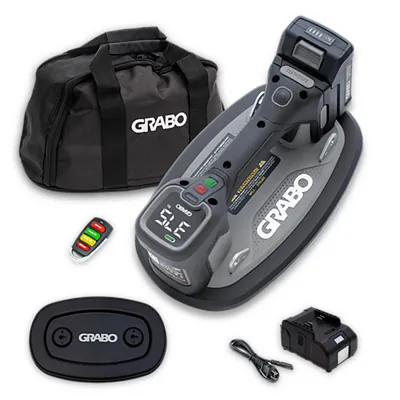
Cordless vacuum lifter
GRABO Pro Brushless: the original cordless vacuum lifter for pavers, stone, glass and panels.
Like what we do? Buying through these links supports Bots n' Beans. We earn a commission at no extra cost to you. Thank you!