
Humanoids · October 30, 2026 · 4 min
Stop counting robots, start counting work: AGIBOT pitches Worken
At its Shanghai Innovation Day, the company that leads the field on volume proposed a new yardstick: active robots, times autonomous hours, times useful output. Here is what it measures, and what it leaves open.
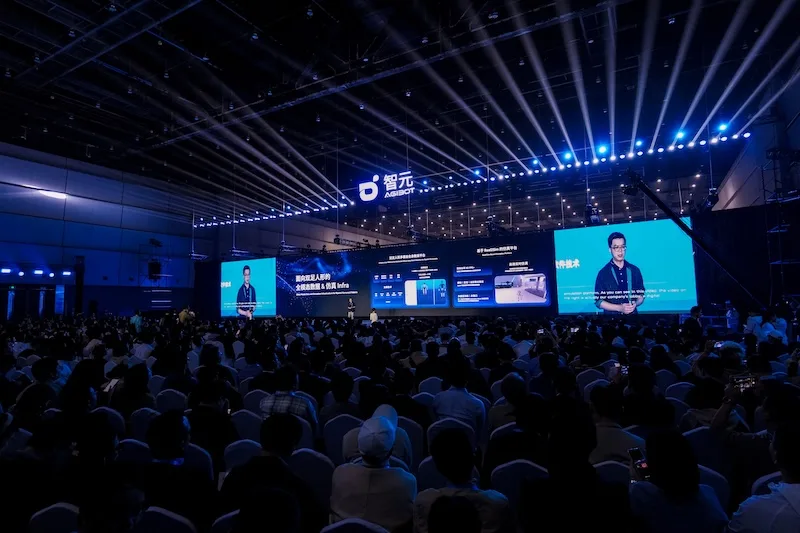
For two years, humanoid makers have kept score with production counts. A company announces its 5,000th robot, then its 10,000th, and the number becomes the headline. AGIBOT has played that game as well as anyone; in September it said its 20,000th robot had come off the line. So it is worth noticing that at its Innovation Day in Shanghai on October 29, the same company stood up and argued that counting robots is not enough.
A unit for work, not shipments
AGIBOT’s proposal is called Worken, a blend of “work” and “token” that the company defines as “Effective Intelligent Work Hours.” The formula multiplies three things: the number of robots actively doing tasks in real settings, the hours they spend working autonomously, and an output efficiency ratio that compares their acceptable output against a reference benchmark for a defined task, such as a human worker held to normal operating standards.
Each term strips out something the industry tends to count. Robots sitting in inventory do not count as active. Hours spent powered on but waiting, or being steered by a person, do not count as autonomous. And a robot that finishes a task slowly or sloppily scores lower on output. Two fleets of the same size could land on very different Worken figures, which is exactly the point.
“We want to move beyond measuring how many robots are built or delivered and begin measuring how effectively they can perform useful work, autonomously and consistently, in the real world,” said AGIBOT co-founder, president and CTO Peng Zhihui.
Why the timing makes sense
The International Federation of Robotics put global humanoid sales for all of 2025 at about 7,000 units, which shows how far apart production claims and real deployment can sit. As the big makers move from demos toward paying customers, buyers want to know what a robot delivers per shift, not how many of its siblings exist. A metric built around autonomous hours and acceptable output speaks to that buyer directly.
It also echoes what we saw this week in the U.S. When GXO expanded Agility’s Digit to two more warehouses, the number Agility leaned on was more than 100,000 totes moved at a single Georgia site, a measure of work done rather than robots built. Worken is, in effect, an attempt to turn that kind of proof into a standard formula that anyone could apply.
There is an economic argument underneath, too. AGIBOT notes that hardware depreciates, while better software and models can let the same machine do more useful work over its life. Measured against lifetime cost, a robot that keeps getting smarter could look better each year, which is a pitch every humanoid company would like to make.
The catch: it is AGIBOT’s ruler
Worken is a proposal, not an industry standard, and AGIBOT says it will refine the framework with task-specific benchmarks and real operating data. The hard part is the output ratio. Moving parts on a tablet line and greeting visitors at a metro station produce very different kinds of value, and whoever defines the benchmark for each task largely decides the score. Until other companies or independent groups adopt it, Worken figures will be AGIBOT’s own numbers about AGIBOT’s own robots.
The metric did get an early boost. It appears in the 2026 Embodied Intelligence Industry Innovation Report released at the event, compiled by China Economic Information Service and the Shanghai Industrial Innovation Center of the China Academy of Information and Communications Technology.
The hardware and software around it
AGIBOT surrounded the idea with products meant to raise those scores. The new G2 Max is a wheeled industrial robot with 21 degrees of freedom, dual arms that can handle up to 40 kg, and a working height range of 0.1 to 2.5 meters, aimed at material transport, warehouse handling and pallet work. The company pointed to G2-family deployments in tablet production at Longcheer, semiconductor packaging and testing, CNC machine tending and logistics, plus service robots at Guangzhou Metro and the Chimelong resort complex.
It also showed AHA3, a third-generation humanoid hardware architecture with liquid-cooled joints, IP67-rated joints for harsher sites, and a new OmniHand 3 family of dexterous hands. On the AI side came GO-3 Preview, a foundation model built to reason about a task, predict outcomes and act, and WITA-Omni 1.0, a model for conversation and expressive interaction. AGIBOT reported first-place results on several benchmarks for both; those are the company’s own figures. Its Link-U OS 1.0 robot operating system is being trialed by partners, with full open sourcing planned by the end of 2026.
How it fits the field
Western rivals tend to sell on capability: Tesla’s Optimus on scale, Figure on its Helix AI, and Apptronik on its Google DeepMind partnership. Chinese makers like UBTECH and Unitree have leaned on shipment numbers and showmanship. AGIBOT is trying to change the scoreboard itself, which is a bold move from a company that already leads on volume.
Our take
Worken is part marketing and part genuinely useful idea. The industry does need a common way to say how much a robot actually gets done, and autonomous hours times acceptable output is a sensible starting point. It will only matter if customers and competitors start reporting it too. Until then, treat it as a good question rather than a final answer. You can compare AGIBOT’s machines with the rest of the field on our humanoids page, and find teams hiring to solve this on our jobs board.