SI · November 5, 2026 · 5 min
Cameras tell a robot what to grab. T-Rex says the fingertips finish the job
Panasonic HD, Berkeley, NVIDIA and partners report a 65% average success rate on 12 contact-rich two-handed tasks by correcting motions from fingertip touch about four times faster than the vision loop. The paper lands at CoRL in Austin next week.
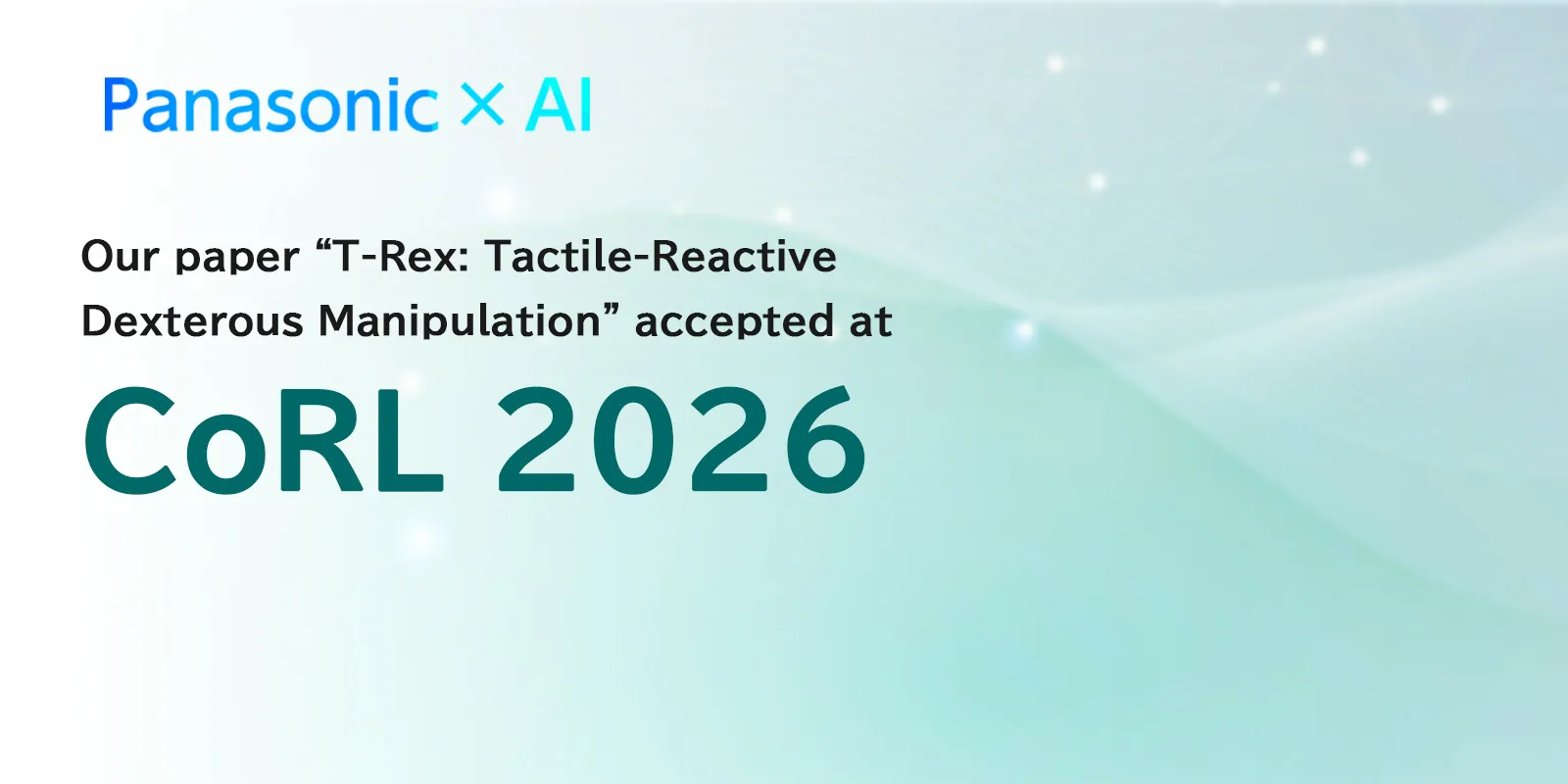
Most robot demos look great until the object slips. A vision-language-action model can line up a grasp from a camera feed, then fail the moment a soft tube flexes, a card slides or a key needs just the right turn. On November 5, Panasonic Holdings, its U.S. research arm and collaborators at UC Berkeley, NVIDIA, Stanford, Sapienza University of Rome and ItalAI put a number on that gap. Their new system, Tactile-Reactive Dexterous Manipulation, or T-Rex, averaged a 65% success rate across 12 real contact-rich tasks. The best comparison method they cite managed 35%. Strip the tactile channel out of T-Rex and the score falls to 42%. Touch is not a nice-to-have here. It is most of the win.
Two clocks, one pair of hands
The design choice that matters is the timing. T-Rex still uses a vision-and-language module to sketch the overall motion, updating at about 5 Hz. A second module watches force and deformation from tactile sensors on all ten fingertips and corrects the action at about 20 Hz. When something starts to slip or the fingers press too hard, the robot can adjust without waiting for another slow pass through image recognition. That split is the practical answer to a mismatch everyone in physical AI knows about: language and cameras think slowly, while contact changes in a blink.
Training followed three stages. The team first soaked the model in 22,889 hours of human egocentric video so it could learn broad visual and motion patterns. Then came mid-training on more than 7,700 bimanual robot episodes, about 100 hours of data spanning more than 200 everyday objects and 22 basic actions, with head and wrist cameras, robot state, natural-language instructions and fingertip signals recorded together. Finally each task got roughly 100 demonstrations for fine-tuning. The evaluation set is the kind of work that looks trivial until you try it with rubber and metal: turning pages, moving an egg, squeezing toothpaste, unlocking a door with a key, pulling out a card and screwing in a light bulb.
Why this story is bigger than a lab score
Humanoid makers sell bodies, but buyers care about hands that do not crush or drop what they touch. We have already watched that pressure show up in logistics, where IDA and Heinz, two Unitree G1s in a German warehouse pilot, are being judged on sorting cardboard and soft mailers with tactile five-finger hands. It also shows up in the supply chain: Chinese firms shipped nearly all of this year’s dexterous humanoid hands, and our humanoid hands guide is where we track the trade-offs. A model that can use those sensors at 20 Hz is the other half of the product.
Compare that with the AI headlines of the past few weeks. Google DeepMind’s Gemini 4 Argon turned a cornhole video into a skill for Apptronik’s Apollo, a clean, repeatable throw in a fixed scene. Figure’s Helix 2.5 generalized chores across 30 homes it had never seen, leaning on a huge human-behavior pretraining set. Those are bets on scale and generalization. T-Rex is a bet on closing the contact loop. Different problems, same industry bottleneck: robots still stumble when the world pushes back.
Panasonic says the near-term use cases are the ones factories and warehouses already hate assigning to people for eight hours: inserting, removing and screwing small parts, and handling soft or fragile goods in logistics. That is not a consumer launch, and the company is not selling a robot with this brain today. It is research headed to the Conference on Robot Learning in Austin from November 9 to 12, where the peer audience will poke at the baselines and the task set.
What to watch
A 65% average on 12 lab tasks is a real jump over 35%, and the tactile ablation makes the claim harder to dismiss. It is still an average across carefully chosen contact-rich jobs, not a shift on a live production line. The interesting follow-ups are whether other labs can match the dual-rate setup with cheaper sensors, and whether humanoid companies already shipping dexterous hands adopt something like it instead of treating touch as a static input.
Our take
Bigger VLAs will keep getting the splashy demos. The quiet unlock for useful two-handed work is reacting to what the fingers feel before the camera catches up. T-Rex is one of the clearest public proofs of that idea this year. We will watch how it lands at CoRL, and how it sits next to the bodies and hands on our humanoids page. If you want to build the next version of this stack, robotics AI roles are on our jobs board.