
Factories · November 22, 2026 · 4 min
AGIBOT’s G2s clock in on phone test lines, at the factory that helps build them
Dozens of Genie G2 robots are now loading and operating smartphone test stations at Lens Technology, which also assembles AGIBOT humanoids. It is a real factory job. It is also the friendliest customer AGIBOT could ask for.
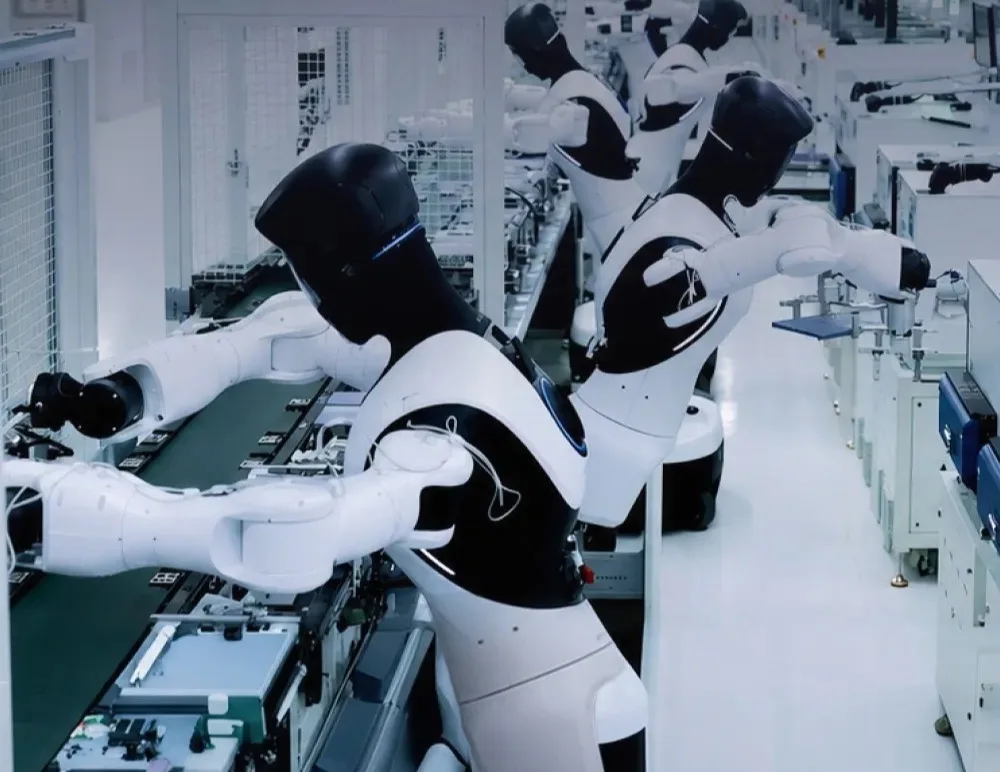
Plenty of humanoid makers talk about the factory jobs their robots will do someday. AGIBOT now has dozens of its Genie G2 robots doing one right now. Chinese business outlets reported on November 20 that AGIBOT and Lens Technology, the big Chinese maker of phone cover glass and components, have signed a strategic partnership, and that a fleet of G2s is already working on Lens smartphone test lines.
The job
The robots handle the stations a phone passes through before it is cleared to ship. They load phones into test fixtures, take them out again and operate the test equipment itself, across stages the reports list as MMI, ANT, CAM and CAMCV. AGIBOT picked this kind of work on purpose: the motions repeat thousands of times a shift, and the setup keeps changing because phone models turn over quickly. Fixed automation has to be rebuilt for each new model. AGIBOT’s pitch is that one general-purpose G2 body can move between lines with far less retooling and can keep running around the clock. Those are the company’s claims, not measured results from Lens.
What nobody has published is the scorecard. The reports say “dozens” of robots and stop there. There is no exact fleet size, no phones-per-hour figure, no count of how often a person has to step in and no word on cost.
The customer is also the contractor
The most interesting detail is who the customer is. Lens is not a stranger kicking the tires. In August 2025 it told investors it had taken on work across AGIBOT’s humanoid lineup, and that it assembles complete robots for several humanoid makers. So the G2s on these test lines are working inside the same company that helps build them.
That cuts both ways. A partner that already knows the hardware can feed problems straight back to the engineers, which is exactly what a young robot needs. But a friendly customer is also the easiest one to win. AGIBOT says it has now completed the whole chain at Lens, from adapting the process to commissioning the line to handing it over, and that the result is a standard delivery playbook it can copy “from 1 to N.” The real test of that claim is a phone maker with no stake in AGIBOT’s success.
What the G2 brings to the bench
AGIBOT introduced the G2 in October 2025 as an industrial robot rather than a walker. It rolls on an omnidirectional wheeled base with a waist and legs that have five degrees of freedom, carries force-controlled arms and dexterous hands with tactile sensing, and runs on an NVIDIA Jetson Thor computer. AGIBOT also trains it with reinforcement learning on real robots, not only in simulation.
It has done factory work in public before. In June, eight G2s took over the quality-inspection stage of a tablet line at Longcheer’s factory in Nanchang and were livestreamed for six days. Chinese outlet PEdaily reported 64,828 operations in 64 hours with a 99.99% success rate. If AGIBOT shares anything close to that for Lens, this deployment will mean a lot more.
How it compares
Electronics makers are quickly becoming the proving ground for two-armed robots. ASUS just introduced Gallop by putting it on one of its own motherboard packing lines, though Gallop is still learning its first station and ASUS isn’t aiming for sales until late 2028. AGIBOT is further along, with a fleet already working rather than a single robot in training. Other Chinese makers are scaling in logistics instead: Robotera has been expanding its parcel-sorting robots across China Post hubs. In the U.S., the timelines run longer. Boston Dynamics’ Atlas won’t begin on-site testing at GlobalFoundries until early 2027, as we covered when Atlas got its chip-fab interview, and Apptronik is still proving Apollo on Mercedes-Benz lines.
Our take
This is the kind of deployment AGIBOT’s own Worken yardstick was built to measure: active robots, times autonomous hours, times useful output. So it is a little ironic that the announcement gives us none of those numbers. Dozens of robots on a live phone line is a real step past demos, and the Longcheer livestream shows AGIBOT can back its claims when it wants to. The next proof should be a throughput figure from Lens, then a second phone maker with no ties to AGIBOT. Follow AGIBOT, compare the G2 with other working robots on our humanoids page, and browse factory robotics openings on our jobs board.