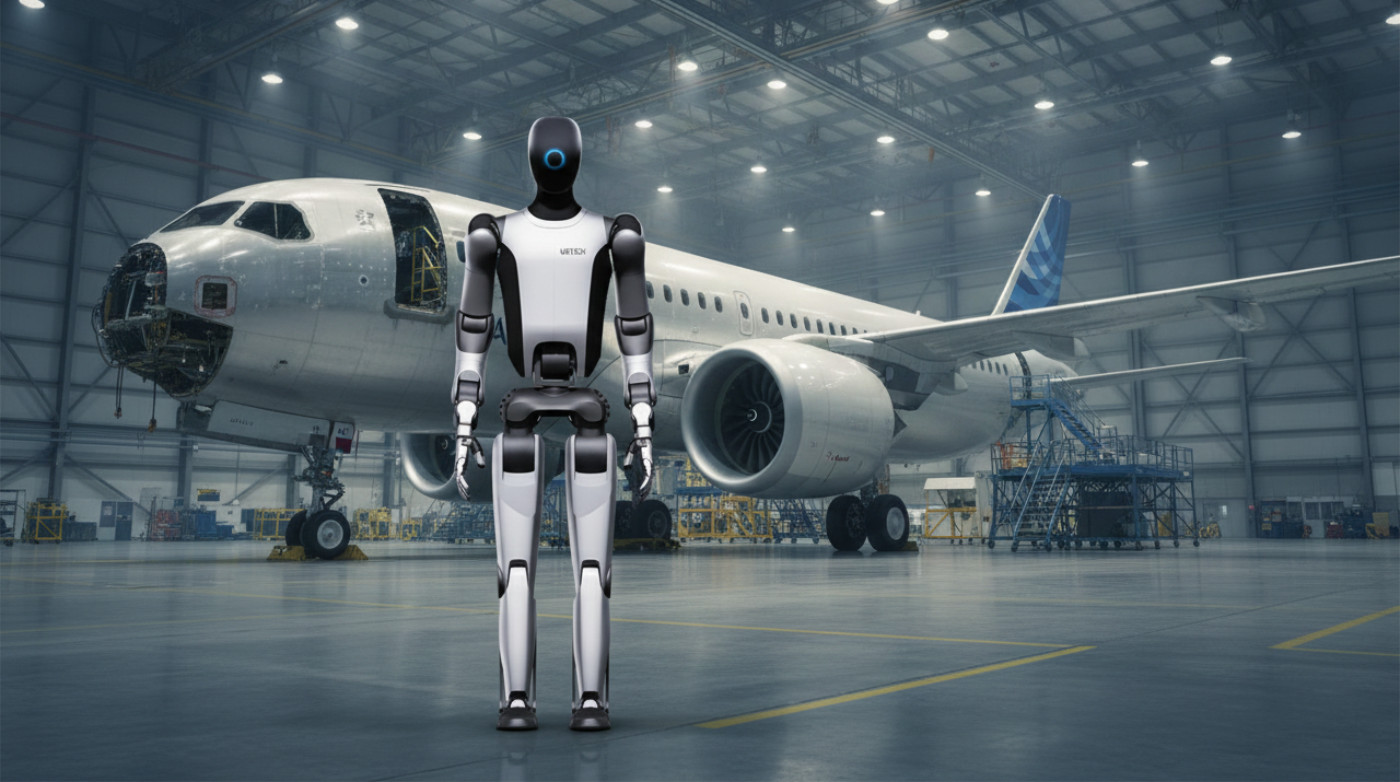
European aviation giant Airbus has entered into an agreement with Chinese robotics company UBTech Robotics. The deal will see Airbus introduce UBTech’s advanced humanoid robots, the Walker S2 model, into its manufacturing processes for testing and development.
The Walker S2 is a full-sized humanoid robot, standing 176 cm (5’9”) tall and weighing 70 kg (154 lbs). It is designed for industrial tasks, featuring dexterous hands with tactile sensors, the ability to carry substantial weight, and a unique function to hot-swap its own batteries for continuous operation. The partnership includes collaborative work to integrate these robots into Airbus’s airplane assembly lines.
While the exact number of units were not disclosed, the purchase is viewed as an initial, exploratory move. An Airbus statement clarified that the cooperation is in the “early concept-testing stage.” This partnership follows a similar deal UBTech struck with U.S. semiconductor maker Texas Instruments in late 2025, signaling the Chinese firm’s aggressive push into global industrial markets.
UBTech has emerged as a major player in the rapidly growing humanoid robotics sector. The company reported that its total humanoid robot order value exceeded 1.4 billion yuan (approximately $201 million) in 2025. With a production facility in Liuzhou, China, UBTech has already shipped around 1,000 Walker S2 units and aims to ramp up capacity to 10,000 industrial humanoid robots in 2026.
The aviation industry represents a new frontier for humanoid robot application, where precision, endurance, and the ability to work in complex environments are critical. If successful, the integration could pave the way for broader adoption of humanoids in manufacturing, potentially affecting labor strategies and production efficiency.
Analysts note that while China is advancing quickly in commercializing humanoid robotics, mass adoption in global industries is still estimated to be years away. For now, the Airbus-UBTech deal is a notable experiment in whether humanoid robots can transition from demonstration videos to becoming viable tools on the factory floor of one of the world’s most technically demanding industries.