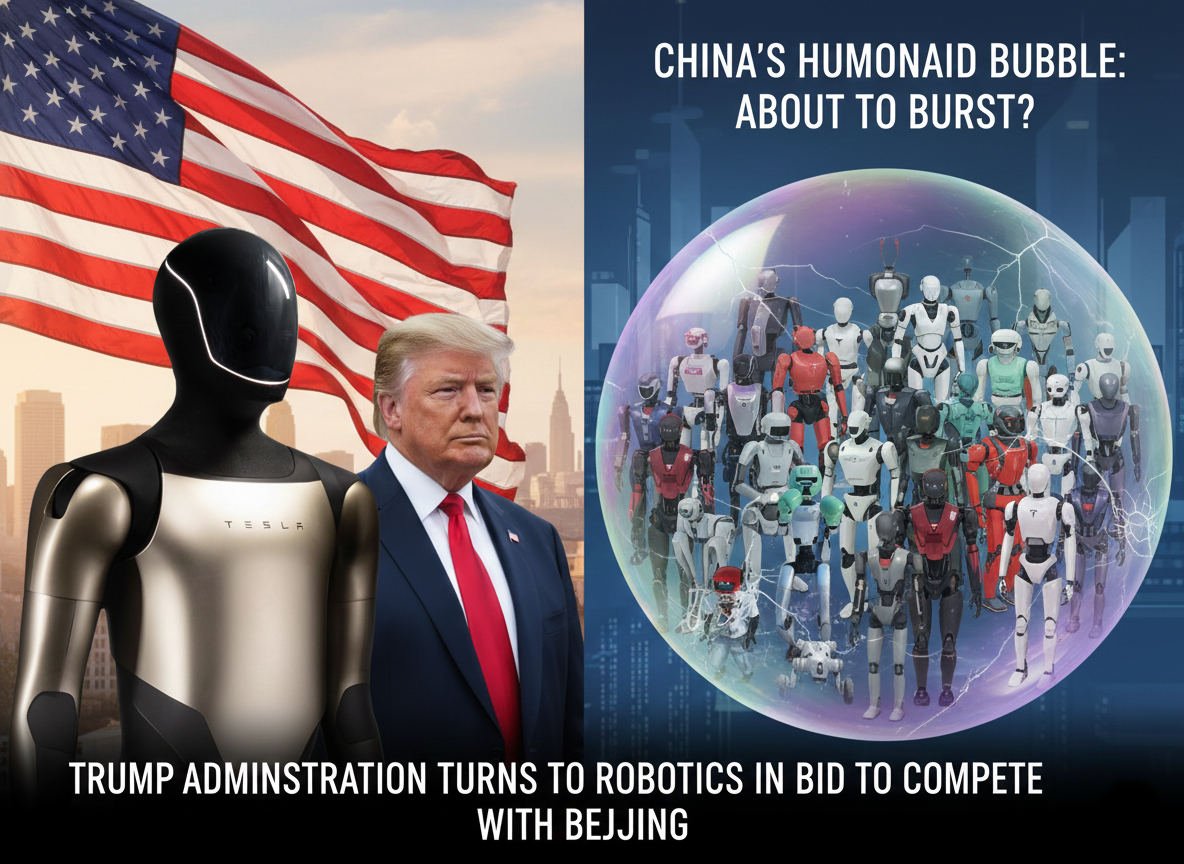
The competition for global dominance in humanoid robotics is playing out as a Tortoise and the Hare scenario. China, the “Hare,” sped out of the gate with massive, subsidized scale, while the U.S., the “Tortoise,” is now ramping up efforts, seeking to leverage its deep technological advantages in AI to play catch-up to China’s industrial volume.
China: The hare runs too fast, creating a bubble
China’s rapid, state-directed investment has successfully generated an immense volume of humanoid production capacity, but this speed has triggered immediate concerns of overheating and a resulting market bubble.
I. The Bubble Warning and the Consolidation Plan
China’s top economic planner, the National Development and Reform Commission (NDRC), has issued a public warning about the risk of a “bubble” in the humanoid robotics sector. This warning is a rare signal of official discomfort with the sector’s growth speed.
- The Problem of Duplication: The NDRC notes that over 150 companies are now operating in the Chinese humanoid space, many of which are producing “highly similar” products. This flood of capital into duplicated efforts risks market saturation and the misallocation of resources away from genuine R&D.
-
The NDRC’s Solution—Forced Consolidation: To prevent a crash that could waste billions in state-directed investment, the NDRC has announced plans to “promote the consolidation and sharing of technology and industrial resources.” This is a deliberate policy to create mechanisms for market entry and exit, which will likely lead to:
- Leveling the Playing Field: The elimination or absorption of weaker, “copy-cat” companies.
- Strengthening Champions: The concentration of resources and technology into a few major national platforms, potentially making China’s consolidated sector a more efficient and formidable competitor.
- Scale Advantage: Despite the risks, China has achieved immediate scale, on track to produce more than 10,000 humanoid robots this year, cementing its current volume lead in manufacturing.
U.S.: The tortoise plays catch-up with policy
The U.S. leads on advanced AI and underlying robot intelligence (the “brain”), but its industrial scale in physical humanoids trails China. Recognizing this gap, the U.S. government is now moving to establish a formal policy to accelerate its domestic industry, essentially playing catch-up to China’s industrial volume.
I. The Trump Administration’s Robotics Acceleration
Following previous policy focused on AI, the U.S. government is now placing high-level emphasis on robotics as a crucial pillar for its economic and security future.
- High-Level Policy Focus: Commerce Secretary Howard Lutnick has stated that the administration is “all in” on accelerating the robotics sector.
- Executive Action Details: The administration is considering issuing a forthcoming Executive Order on Robotics to coordinate and accelerate domestic development. The policy is explicitly tied to “bringing critical production back to the United States,” highlighting a direct strategic response to China’s industrial dominance.
- The Genesis Mission Context: This focus builds upon existing executive action, such as the “Genesis Mission” (launched via a recent Executive Order), which directs the Department of Energy to leverage national labs and supercomputers to create AI foundation models and power “robotic laboratories” for accelerated scientific discovery, which includes applications in advanced manufacturing.
Will the tortoise win?
The Hare (China) achieved a quick volume lead with humanoids, but this haste has now forced an internal market correction, requiring complex government-led consolidation. The Tortoise (U.S.) is now using targeted policy to accelerate its industrial base and close the manufacturing gap in order to leverage its fundamental technological strengths by quickly deploying its platforms at scale.
If the U.S. policy can effectively bridge the current volume deficit while China grapples with its market bubble, the Tortoise could gain a decisive advantage in the race to deploy affordable and highly capable humanoid robotics globally.